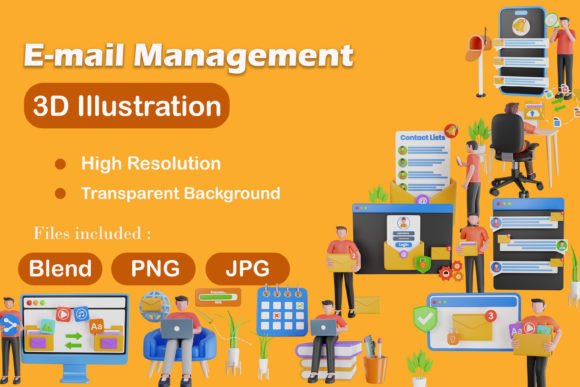
3D Illustration of Email Management
Email has become an essential part of both personal and professional communication. Whether you're managing client correspondence, running a digital marketing campaign, or simply staying on top of daily messages, visual clarity and organization are key. Enter the 3D Illustration of Email Management, a design solution that brings depth, structure, and creativity to email-related visuals. This 3D design concept is particularly relevant for professionals working in web creation, UI/UX design, banner development, and broader web design projects.
Understanding the Concept
The 3D Illustration of Email Management is a stylized representation of various email activities—like replying to messages, organizing folders, and designing promotional emails—presented in a three-dimensional format. These illustrations often feature realistic elements such as floating icons, layered folders, animated cursors, and interactive buttons, all rendered with a high level of detail. The result is not only visually appealing but also functionally informative, making it easier for users to understand complex workflows at a glance.
This type of illustration is crafted using tools like Blender, Adobe Photoshop, and Illustrator, allowing for maximum flexibility and customization. Each image can be adapted to suit different color schemes, branding needs, and user interface styles. With its focus on interactivity and spatial representation, this design bridges the gap between abstract concepts and tangible visual experiences.
Practical Applications in Web Design
When it comes to web design, the right visuals can make or break user engagement. A 3D illustration of email management can serve as a powerful asset in several contexts:
- UI/UX Design: Incorporating these illustrations into dashboards or app interfaces helps users visualize their email tasks more clearly. For example, a floating folder might represent an inbox filter, while a glowing envelope could indicate unread messages.
- Email Marketing Campaigns: Use them to highlight features within your newsletter templates, such as call-to-action buttons or promotional banners, giving your content a modern and dynamic look.
- Banners and Landing Pages: High-resolution 3D images can draw attention and convey functionality quickly, which is especially useful when promoting email tools or services.
- Web Creation Projects: Developers and designers can use these assets to create intuitive email clients or help pages that guide users through common actions like sorting, archiving, or replying.
These applications aren’t just about aesthetics—they enhance usability and reduce cognitive load by presenting information in a more digestible and engaging way.
Enhancing Communication and Clarity
One of the standout benefits of using a 3D illustration of email management is how it supports clearer communication. In digital environments where time is valuable, visuals that explain processes or highlight features can eliminate confusion and streamline user experience.
Consider a SaaS company offering email automation tools. By embedding a 3D illustration showing how emails flow from one folder to another based on rules, they can instantly communicate the product’s functionality without lengthy text explanations. Similarly, educational platforms teaching email etiquette or productivity techniques can use these visuals to demonstrate best practices in a more interactive manner.
Supporting Creativity and Brand Identity
Designers and marketers often struggle to balance creativity with practicality. The 3D illustration of email management offers a unique way to infuse personality into otherwise mundane digital spaces. Its versatility allows for seamless integration with brand colors, fonts, and themes, ensuring consistency across all touchpoints.
For instance, a boutique e-commerce store might use a vibrant 3D illustration of an inbox filled with promotional emails styled in their signature brand palette. This reinforces brand identity while educating users on how to manage their communications effectively. Freelancers and small business owners can leverage similar designs to showcase their expertise in email-based workflows, adding a layer of professionalism to their websites and portfolios.
Increasing Efficiency in Digital Workspaces
Efficiency is a cornerstone of good design, and 3D illustrations contribute significantly to this goal. When used in internal dashboards or customer-facing portals, these visuals can guide users through tasks more intuitively than flat graphics ever could.
A real-world example would be an online learning platform that uses a 3D illustration of an email system to show students how to access course updates via email notifications. Instead of relying solely on written instructions, the illustration acts as a visual roadmap, reducing the need for support queries and helping users navigate independently.
Who Can Benefit Most?
While anyone involved in digital design can appreciate the value of 3D illustrations, certain groups stand to gain the most:
- Web Developers and UI/UX Designers: These professionals can use the illustrations to prototype interactive email systems or enhance existing layouts with lifelike elements.
- Email Marketing Agencies: Showcasing campaigns becomes more compelling when supported by rich 3D visuals that reflect the complexity and effectiveness of the strategy.
- Entrepreneurs and Startups: Building a polished digital presence is crucial. These illustrations offer a cost-effective way to elevate the look of landing pages, tutorials, and product demos.
- Content Creators and Bloggers: Visual storytelling is key in today's content-driven world. Adding a 3D illustration of email management can help explain processes in a way that resonates with readers.
- Corporate Trainers and Educators: Teaching digital literacy or software usage becomes more engaging with interactive 3D visuals that mirror real-world actions.
Each of these roles finds specific utility in the design, whether it's for improving navigation, enhancing presentations, or simplifying user guidance.
File Formats and Technical Considerations
What makes the 3D illustration of email management even more accessible is the variety of file formats provided. Users receive 10 3D Blender files, along with 10 JPEGs and 10 PNGs. This ensures compatibility with multiple design workflows and platforms:
- Blender Files: Ideal for designers who want to customize or animate the illustrations further. You can tweak lighting, angles, or add motion effects to match your project’s requirements.
- JPG and PNG Files: Ready-to-use images perfect for static website elements, social media posts, or print materials. Their high resolution (3000x2000) means they look sharp on any screen size or display.
Whether you’re building a new web application or redesigning an old one, having access to these diverse formats gives you the freedom to choose what works best for each scenario.
Real-World Use Cases
To better illustrate the practical impact of these designs, let’s consider a few scenarios:
Imagine a startup launching an email scheduling tool. They include a 3D illustration of an email being dragged into a calendar slot. This simple yet effective visualization communicates the tool’s core functionality without needing technical jargon.
Or picture a blog post about email segmentation strategies. Using a 3D illustration that shows different colored folders representing segmented audiences can help readers grasp the concept more quickly and apply it to their own campaigns.
In corporate training modules, a 3D scene depicting an employee replying to an email with a floating response box can serve as a visual aid for explaining proper communication protocols in a digital setting.
Limitations and Considerations
While the 3D illustration of email management is a versatile tool, it's important to consider its limitations. Not every project requires a 3D element, and sometimes simpler visuals may be more appropriate depending on the audience and context.
For instance, if you're targeting users who prefer minimalistic interfaces, too much 3D animation or depth could overwhelm them. It's always wise to test these illustrations in real-world settings to ensure they align with user expectations and don't hinder performance due to large file sizes or slow rendering times.
Additionally, while Blender provides a robust foundation for customization, users unfamiliar with 3D modeling may find the process challenging. That said, many of the pre-rendered JPG and PNG files are ready to deploy immediately, minimizing the learning curve for those who just need high-quality visuals without deep technical edits.
Conclusion
The 3D illustration of email management is more than just a decorative asset—it's a functional design element that enhances understanding, improves efficiency, and adds a creative edge to digital projects. From email marketing to web development, these visuals have the potential to transform how users interact with email-centric tools and content.
With its broad compatibility and availability in multiple formats, it’s a valuable resource for professionals looking to innovate their digital presentations. Just remember to assess your specific needs before integrating 3D illustrations, ensuring they serve a clear purpose rather than merely adding visual flair.